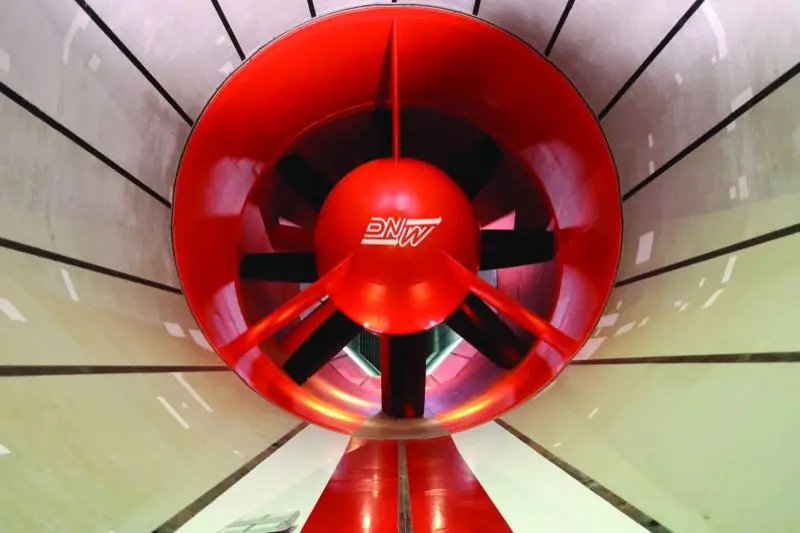
German-Dutch Wind Tunnels (DNW) marked the 50th anniversary of its Large Low-Speed Facility (LLF) at Marknesse in the Netherlands this June, with the site now running near full capacity and turning away work due to a full order book. The facility, jointly run by NLR and DLR, was originally designed for a 20-year service life. Celebrations included a formal event, an open day attracting over 1,500 visitors, and publication of a history book, DNW50.
Directors Joost Hakkaart (NLR) and Holger Mai, who succeeded Andreas Bergmann as German director on 1 June 2025, attribute the tunnel's longevity to its flexible multi-test-section design, originally a compromise between differing Dutch and German requirements, and to continuous technical upgrades drawn from its two parent research institutes. One example cited is the adaptation of turbine-powered simulator units, now benefiting from improved electric motor power density, allowing combined scaled engine performance and acoustic simulation.
Staffing has doubled over the past five years to around 120 across DNW's sites, enabling parallel operation of all facilities and double shifts when needed, a marked recovery from a downturn in the late 2010s and early 2020s. Test campaigns range from single days to six months, with full projects spanning several years. Demand is being driven partly by sustainable aviation programmes and multiple eVTOL developments.
Airbus, a long-standing customer since the A300 program, credits DNW testing, including combined engine and moving-belt ground simulation, with maturing the A320's configuration. Hakkaart notes that as aircraft configurations diversify beyond conventional tube-and-wing designs, experimental validation is regaining relevance where CFD has yet to catch up, particularly for engine-airframe interference during take-off and landing.
Source: Aerospace Testing International — read the original article