
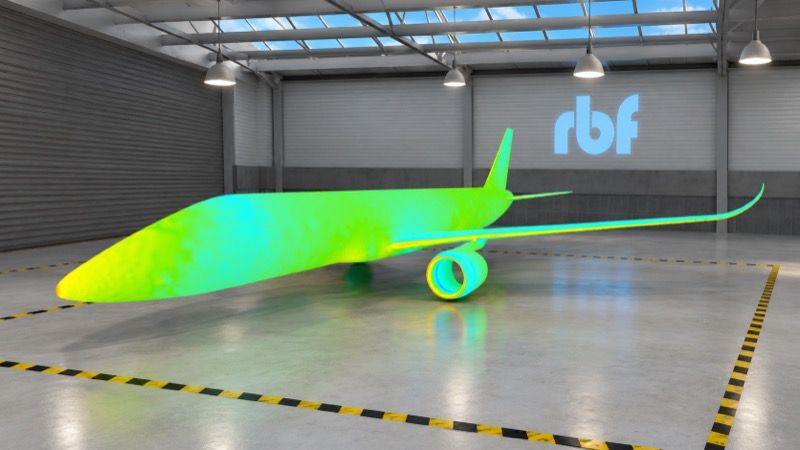
RBF Morph, an Italian mesh-morphing and simulation software company, has released rbfCAE, a platform that combines artificial intelligence, virtual reality and reduced-order modeling for design and simulation workflows. The system uses the firm's mesh-morphing technology to generate geometric variants and synthetic datasets, which feed AI-based reduced-order models built on proper orthogonal decomposition and deep learning. These models can estimate a new geometry's aerodynamic, structural or thermal behaviour almost instantly, along with a reliability score, rather than requiring a full solver run.
The platform is built from four linked modules: rbfROM, which compresses large simulation datasets into near-real-time reduced-order models; rbfVR, which puts these models into a VR environment so users can alter geometry with hand gestures and see performance feedback immediately; rbfADJOINT, which flags how a given design change affects key performance indicators; and rbfROC, which feeds geometric changes back into the CAD model, updating meshes and CAD data to match simulated deformations. A connector suite, rbfCONNECT, links rbfCAE to major commercial and open-source solvers, synchronizing multiple physics domains within one automated workflow. RBF Morph states this multisolver automation can cut workflow time by up to a factor of five compared with conventional processes.
Leonardo has trialled the platform in a proof-of-concept under Italy's PNRR programme with the DAMAS Digital Hub, integrating rbfCAE with HPC infrastructure to build scalable industrial demonstrators. Nissan's R&D digital team has also applied the multiphysics workflow to speed up exploration of lighter structural designs. RBF Morph additionally cites use in aerospace analysis of full-scale aircraft concepts and in a European project developing VR-based surgical demonstrators for pediatric cardiac procedures.
Source: Aerospace Testing International — read the original article