
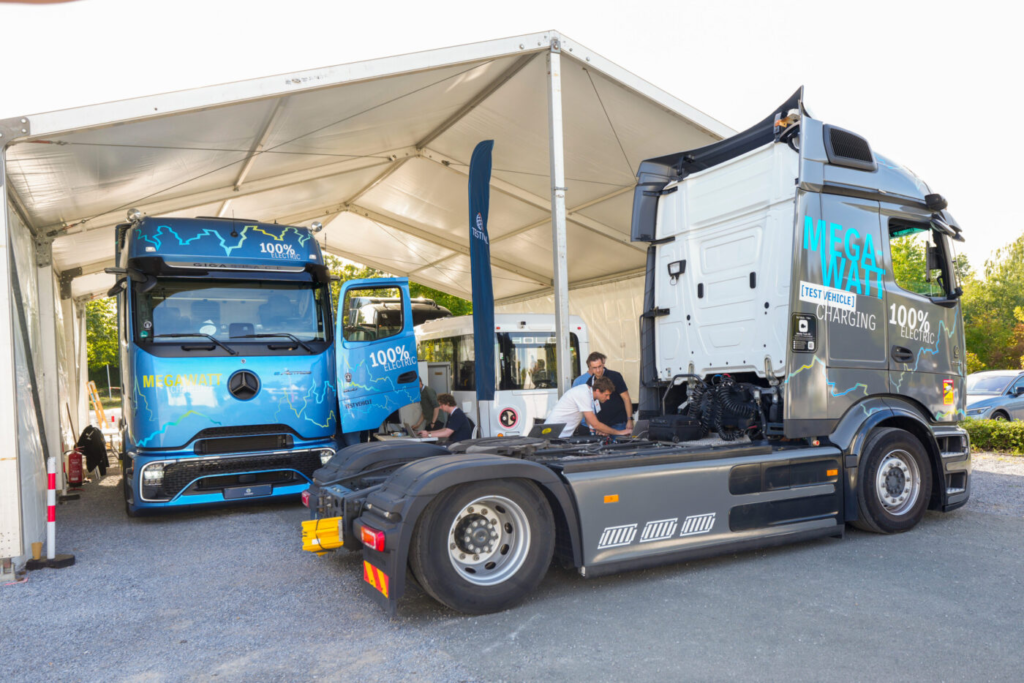
At the CharIN Testival & Conference Europe, host Phoenix Contact provided a CCS charging point rated up to 720 kW for interoperability testing between vehicles and charging hardware from different manufacturers, including unreleased technology. A live high-power charging demo with a Mercedes-AMG needed several attempts before vehicle and charger established communication — a reminder that, despite years of standardisation work, cross-vendor interoperability is still not guaranteed by default.
CharIN CTO Michael Keller pointed to ISO 15118-20 as the area of greatest progress, with more manufacturers now implementing it in test and production vehicles. The July 2026 amendment (ISO 15118-20:2022/Amd 1:2026) adds MCS services, AC-DER functions for grid integration, and a revised security concept. Note that the standard governs communication only; the physical MCS connector is defined separately in IEC TS 63379. Testing in Arnhem in May covered Amendment 1, TLS 1.3, and MCS plug/inlet mechanics, and CharIN flagged remaining issues with compatibility and locking mechanisms.
On the commercial-vehicle side, MCS charging power figures presented included up to 1,000 kW for the Mercedes-Benz eActros 600, 750 kW for the MAN eTGX, and 700 kW for the Volvo FH Aero Electric, with charging increasingly factored into vehicle architecture from early development.
Bidirectional charging remains less mature: of the DC test systems at Arnhem, 13 of 23 supported bidirectional flow, versus 7 of 11 on AC, with grid emulators used to approximate real network conditions. CharIN still rates V2G implementation and compliance with European grid codes as early-stage, alongside growing cybersecurity requirements tied to expanding communication paths.
Source: electrive.com — read the original article