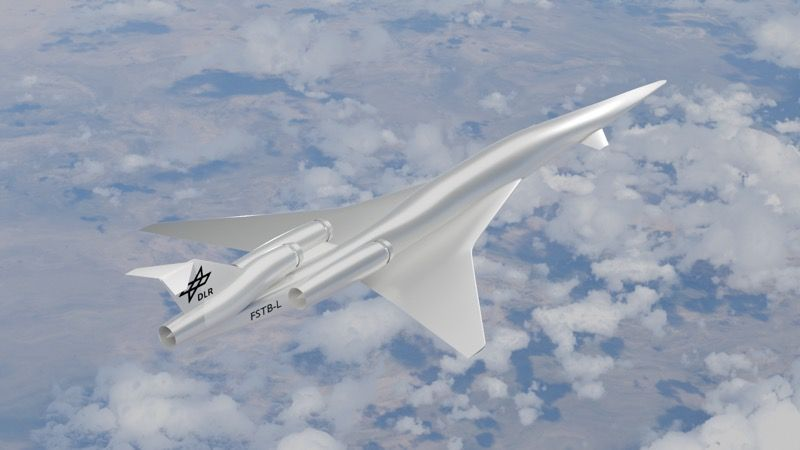
The German Aerospace Center (DLR) has launched STORMIE-2, a follow-on project applying higher-fidelity computational methods to predict noise and sonic boom signatures of civil supersonic aircraft. The work aims to generate technical evidence for international certification standards that currently do not exist for this class of aircraft, leaving both manufacturers and regulators without a reliable basis for design and rule-making decisions.
Building on the original STORMIE project (2023–2026), which developed an integrated design and assessment platform for supersonic configurations, STORMIE-2 reanalyzes three previously designed configurations using improved aerodynamic and flight-mechanical methods. Additional design variants are being studied to characterize sensitivities and uncertainties and to quantify their impact on environmental performance. Aerodynamic analysis relies on DLR's TAU solver and CODA, a CFD code co-developed by ONERA, DLR and Airbus, while flight characteristics and pilot visibility are assessed using the Air Vehicle Simulator (AVES) in collaboration with other DLR institutes.
The project also examines fleet and airport-level scenarios to understand the broader effect of supersonic operations on the air transport system. DLR describes its role as that of a "virtual manufacturer" bridging industry and regulatory authorities, and will feed findings through nominated experts into ICAO's Committee on Aviation Environmental Protection (CAEP), which is drafting environmental standards for future supersonic certification. Selected configurations and results will also be shared with interested partners, subject to export control compliance.
Source: Aerospace Testing International — read the original article