
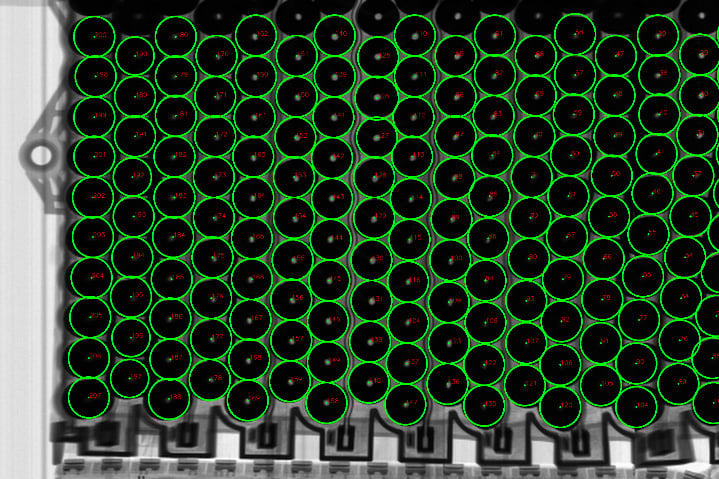
Fraunhofer IIS, working with Munich University of Applied Sciences, has added an automated evaluation software library to its AIR X-ray inspection method for EV high-voltage batteries. The underlying scanning setup, first shown in 2024 and trialled on over 100 vehicles, X-rays complete battery packs without opening the housing, using a car-wash-style arrangement with the source above and a detector below. What is new is that the resulting 2D projections no longer require manual review: the software automatically locates cylindrical, prismatic, and pouch cells and flags geometric anomalies such as shifted or deformed cells and swelling. Evaluation of a full pack took around five minutes in the test setup, on top of the roughly ten-minute scan time for a complete vehicle, with total duration depending on pack size and projection count.
The method is not meant to replace electrical State of Health testing but to add mechanical-integrity data, which SoH figures alone cannot capture. In a demonstration case, a VW ID.3 rear-ended a stationary Tiguan at 79 km/h under DEKRA test conditions; despite visible front-end damage, the software found no safety-critical irregularities in the underfloor battery's pouch cells, based on automated comparison of cell-edge curvature across nine modules. Combined with DEKRA hazard assessment, EDR and BMS data, and further electrical tests, the pack was rated EUCAR hazard level 0 and cleared for reuse. A separate crash-damaged pack with cylindrical cells showed detectable cell shifting and deformation and was rejected for further use despite no swelling.
Fraunhofer sees potential applications in second-life battery assessment and, longer term, in periodic technical inspection concepts, though no concrete rollout plans exist yet. A future "Giant Eye" CT system at the Fürth development centre is intended to extend the approach to full 3D analysis of complete vehicles.
Source: electrive.com — read the original article