
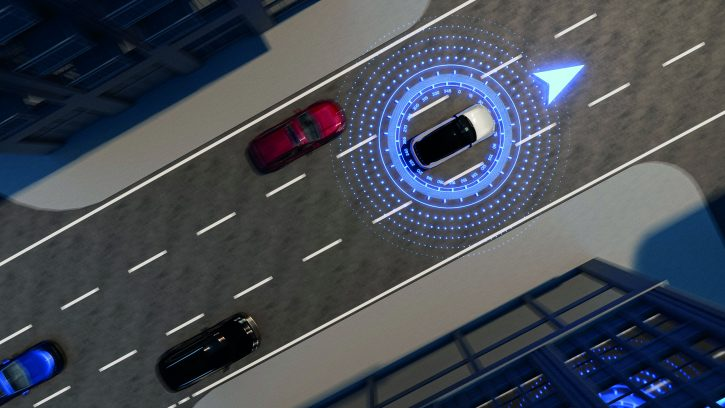
Focal Point Positioning has detailed a new technology, Precise+, that aims to close a long-standing gap in high-precision GNSS: while carrier-phase receivers can reach 10cm-level accuracy in open sky, they typically collapse to standard code-phase accuracy—several metres or worse—as soon as signals are blocked or reflected in urban canyons or under tree canopy. Speaking to ADAS & Autonomous Vehicle International, VP of engineering Steve Mole explained that Precise+ extends the company's existing Supercorrelation technique, previously used in its S-GNSS product for standard GNSS, to carrier-phase tracking.
Supercorrelation works by precisely modelling local timing and antenna motion, enabling long coherent signal integration and giving the receiver angular sensitivity it would not otherwise have. This allows the antenna's gain pattern to be adjusted in software to suppress reflected or diffracted signal paths, rather than passively accepting all incoming energy as conventional single-antenna receivers do.
According to Mole, a Precise+ receiver matches existing high-precision receivers in open sky, at better than 1m accuracy, but continues to deliver sub-metre positions in obstructed environments where standard high-precision units fall back to multi-metre code-phase accuracy. Because no extra correction data or hardware changes are needed—only a software update—Focal Point positions Precise+ as a way to extend reliable GNSS-based localization further into urban and mixed environments for autonomous and highly automated driving systems, widening their usable operational design domain.
Source: ADAS & Autonomous Vehicle International — read the original article